
Osceola County Arrest Warrants Explained
An arrest warrant tells a peace officer to take a named person into custody. It exists in Osceola County only after a prosecutor or municipal attorney asks for it and a judge or magistrate finds probable cause on a written complaint. MCR 6.101 sets out the complaint itself. MCR 6.102 governs the probable-cause finding that follows. Michigan does not hand these out by default. The rule generally favors a summons instead. A warrant needs a reason, such as an assault or domestic violence charge, a likely failure to appear, a public safety concern, or a prosecutor's request. That is why an Osceola County warrant search starts with the court that made the call, since the file explains which path the judge chose.
Note: An arrest warrant authorizes custody, while a summons only orders a person to appear in court.
How a Complaint Becomes an Osceola Warrant
An Osceola County warrant begins on paper, not in a patrol car. The first step is a written complaint. Under MCL 764.1a, a judge or magistrate must find probable cause before any process issues. That review can rest on the complaint alone, an affidavit, or sworn testimony. The same review also chooses the paper: a warrant or a summons. From there, MCL 764.1b spells out what an Osceola County arrest warrant has to do. It names the person and the offense, directs a peace officer to make the arrest, and requires the person to go before a magistrate without unnecessary delay. The officer then returns the warrant to the court with word of the result.
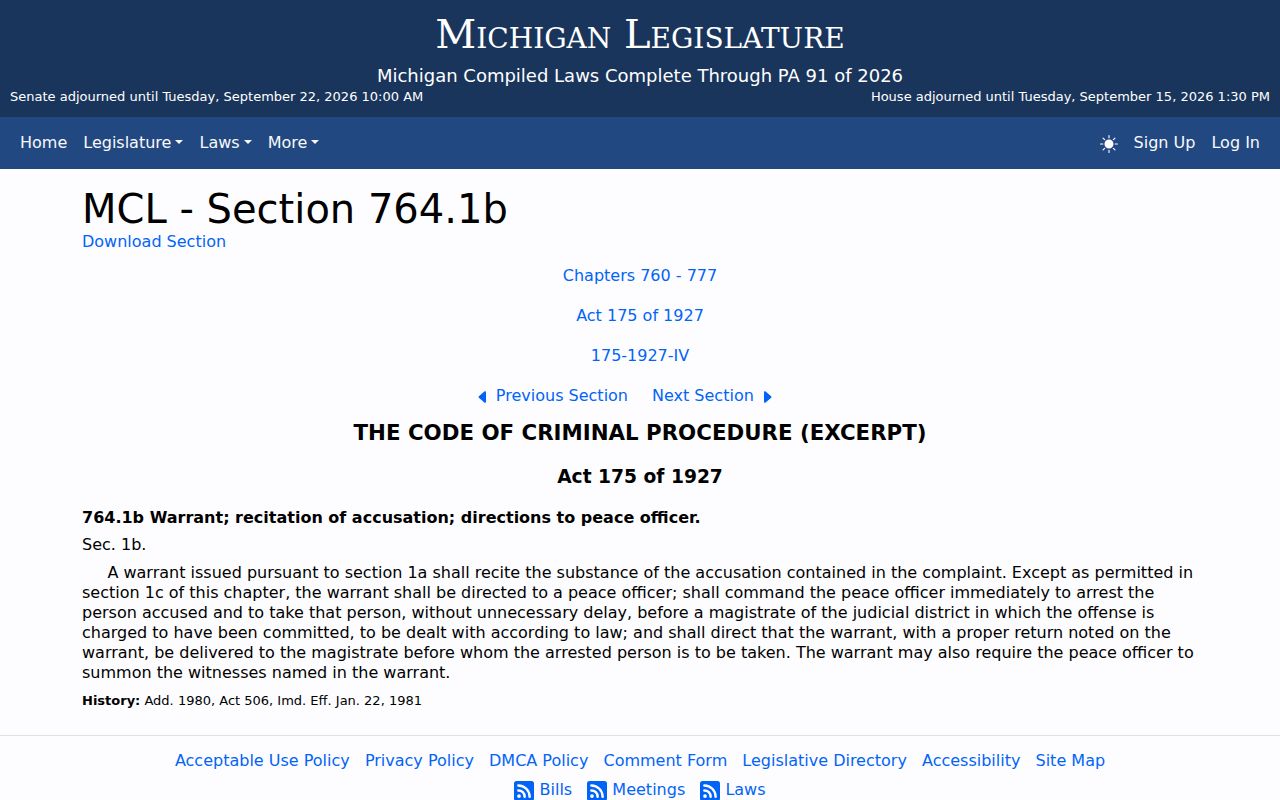
No Osceola County sample warrant form is published. The statute itself is the best public description of what the document contains.
Inside an Osceola County Arrest Warrant
An Osceola County arrest warrant stays short on purpose. It identifies the person and the offense, and it carries the court's authority to act.
| Court and county | The issuing court, such as the 77th District Court in Reed City |
|---|---|
| Case number | The docket identifier, in the 2026-0123457-FY style a court screen shows |
| Subject identification | The name and identifying details that let an officer match the right person |
| Offense | The alleged offense and the statute it is filed under |
| Command and direction | The instruction to a peace officer to arrest and bring the person before a magistrate |
| Interim bail and return | Any release condition the court set, and the officer's report back to the court |
Osceola Arrest Warrant Authority at the 77th
The 77th District Court posts its own explanation: a magistrate there may issue arrest and search warrants when a prosecutor or municipal attorney authorizes the request. The prosecuting side sends it over, and the magistrate weighs it against the complaint. MCL 600.8511 lists warrant authority among a district magistrate's duties. That is why a district court can act before any circuit case exists. A felony still reaches the 49th Circuit Court after preliminary examination and bindover, but the first warrant in the chain is usually a district court document.
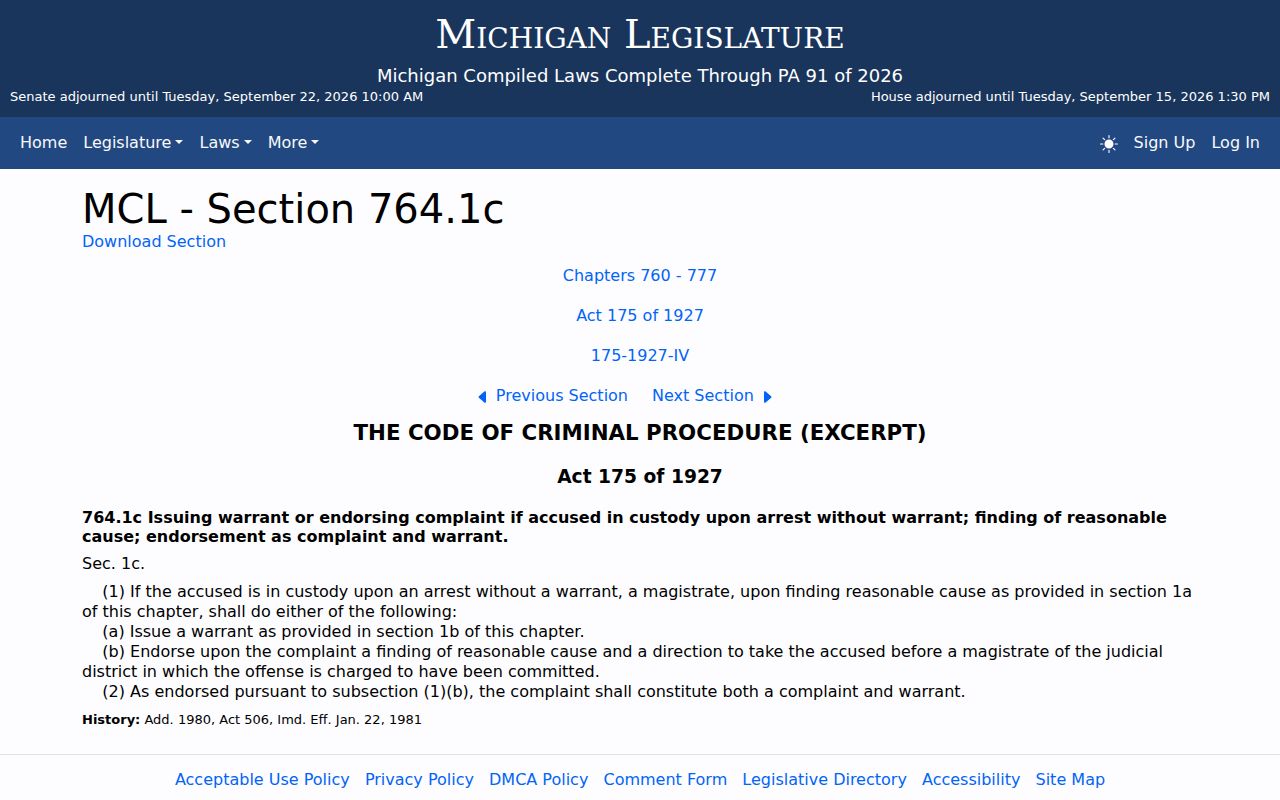
One related provision deserves a look. MCL 764.1c lets an Osceola County court issue a warrant after a warrantless arrest, once reasonable cause is shown.
Serving Arrest Warrants in Osceola County
Judges and magistrates in Osceola County issue warrants; peace officers serve them. The agency on the receiving end varies. It may be the Osceola County Sheriff, Reed City Police, Evart Police, the Michigan State Police, or another authorized partner, depending on the warrant and where the person turns up. Every service ends in a return. The officer reports the outcome to the issuing court, and that return lands in the case file. The LEIN entry behind it is a separate operational record, closed to the public. Questions about execution go to the sheriff at (231) 832-2288. Case status questions go to the issuing court. For the public, MiCOURT Case Search shows whether a case exists at all, and a written request is the fallback for policy or aggregate-count questions. The county FOIA coordinator handles those under Michigan's Freedom of Information Act.
Felony Arrest Warrants in Osceola County
Felony cases switch courts midstream. The 77th District Court handles arraignment, bail, and the preliminary examination, and the 49th Circuit Court takes over once a judge binds the case over. That circuit is shared with Mecosta County. Circuit paperwork can cross a county line. The split matters to anyone tracking a file. A district search may capture the early events while the felony record sits with the circuit court and the Osceola County Clerk.
Note: Once a case is bound over, route the question to the circuit court rather than the district counter.
Comparing Arrest, Summons, and Bench Warrants
Three papers, three different jobs in Osceola County. Where each one comes from decides which clerk can help.
| Feature | Arrest Warrant | Summons | Bench Warrant |
|---|---|---|---|
| What it does | Authorizes custody | Orders an appearance | Enforces an existing case |
| What starts it | A complaint and probable cause | A complaint and probable cause | A missed date or unmet obligation |
| Usual issuer | A judge or magistrate | The court, without an arrest command | The judge holding the case |
| Typical local court | 77th District or 49th Circuit | 77th District or 49th Circuit | The court that set the case |
In Osceola County, a summons orders a court appearance, not an arrest, and a bench warrant punishes a missed one; it adds no new charge.
Search Warrants Are Not Osceola Arrest Warrants
Michigan's search-warrant statute, 1966 PA 189, does something different from an Osceola County arrest warrant. It lets officers search a place, a person, or property after an affidavit and a finding of probable cause. The document never names a wanted person as a lookup result. Its purpose is evidence, not an arrest. So a search warrant will not show up as an active warrant on a warrant search. One wrinkle matters, though. Affidavits and returns in search-warrant files can stay sealed or withheld while an investigation runs, which is one reason the public index looks thin. A judge can also issue a search warrant in a case that already has an outstanding warrant, so the two can sit in the same Osceola County file without meaning the same thing.
If There Is an Arrest Warrant for You
An active arrest warrant flips the sequence in Osceola County. Confirm the warrant and get legal advice before you walk into court, because Michigan law gives you a defined route back before a judge.
- Identify the issuing court and the case number, using a court record rather than a private list.
- Speak with a Michigan attorney about a voluntary appearance, a recall, and the release conditions that may apply.
- Call the clerk and ask what the court requires before an appearance, including documents, timing, and whether counsel should file first.
- Follow the court's instructions, and confirm the new status in writing afterward.
Important: Do not wait for a traffic stop to resolve an open warrant, and do not assume a payment clears it.
Osceola County warrant records start with one rule that favors you. Under MCR 6.105, if you walk into the issuing court within a year, the court must arraign you within two hours when it is available. Otherwise it recalls the warrant and sets a new date. The steps for clearing a warrant are gathered on the home page.
Osceola Arrest Warrants and the Federal Layer
A federal warrant is not an Osceola County record. Living at an Osceola address makes a case no more federal, either. The issuing court decides that question. Osceola County falls inside the Southern Division of the U.S. District Court for the Western District of Michigan. Its Grand Rapids courthouse sits at 399 Federal Building, 110 Michigan St. NW, Grand Rapids, MI 49503, and answers at (616) 456-2381. Federal dockets are open through PACER and the court's electronic filing system. Fugitive matters belong to the U.S. Marshals Service. A docket may list a criminal case or a warrant-related filing while saying nothing about whether the warrant was executed.