
Osceola County Bench Warrants Explained
A bench warrant orders an arrest. It targets someone who failed to meet a court obligation, and it comes from the bench rather than from a new criminal charge. The usual trigger is a missed date. An unpaid judgment or an unfinished court requirement can also start one. The warrant attaches to the case already open. In Osceola County, the 77th District Court is where that usually happens, since a missed date there is the common path. The district page describes criminal matters heard by its judge and magistrate, with separate clerks for criminal, civil, and traffic work. Knowing the right clerk saves a step.
MCR 6.103 and Osceola Bench Warrants
Michigan Court Rule 6.103 governs a criminal failure to appear, and it is the rule a clerk works from. The rule usually allows 48 hours first. That window excludes weekends and holidays before a bench warrant issues. If the person still does not appear, the court generally issues the warrant unless there is good reason for a hearing. Exceptions move faster. Assault or domestic violence charges, a prior failure to appear, or a specific immediate circumstance can justify action in Osceola County without waiting out that window. The clock matters, so note the missed date.
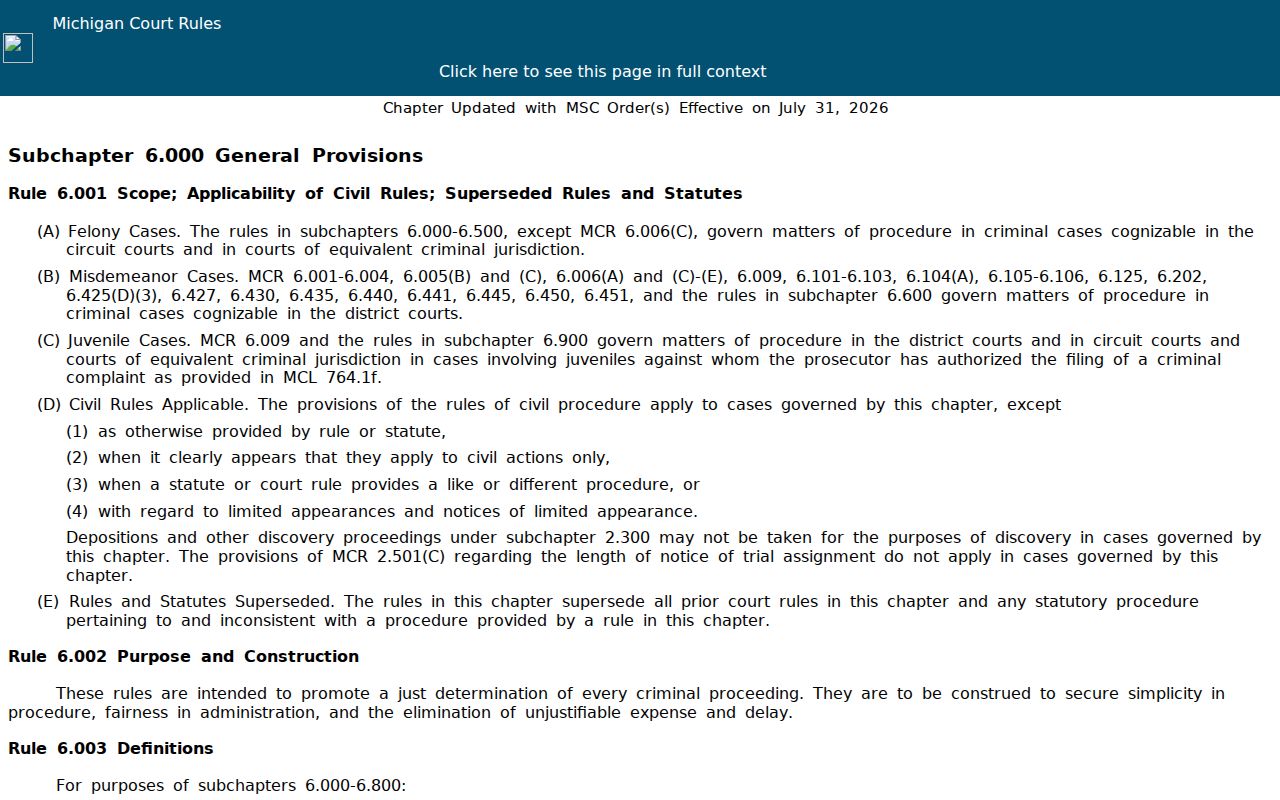
Chapter 6 carries the failure-to-appear, arraignment, and voluntary-appearance rules in sequence.
Note: The 48-hour framework is a rule, not a promise, and a judge decides what happens in a specific case.
How Osceola County Bench Warrants Are Issued
The judge who holds the case signs the warrant, usually after a clerk records the missed appearance. Nothing new has to be charged. The order describes the underlying offense and directs a peace officer to take the person into custody and bring them before the court. Once signed, the warrant enters the Osceola County court's record. It may also reach the operational system officers use. A public case screen may show an event, a failure-to-appear entry, or nothing at all. That is why the clerk remains the reliable source. Michigan has no separate fine-collection writ in local practice, so no Osceola County source uses the word capias. Say bench warrant to a clerk here.
Osceola Bench Warrant Clerk Routes
The right phone number depends on the case. The 77th District Court splits criminal and traffic work between two clerks, and circuit matters leave the Osceola County district court entirely.
- Criminal matters: 77th District Court, option 1, for arraignment, bail, and failure-to-appear questions
- Traffic matters: 77th District Court, option 3, for ticket status and missed traffic dates
- Circuit felonies: 49th Circuit Court at (231) 832-3261 ext. 2, after a case is bound over
- Juvenile and family matters: 18th Probate District, where public access is restricted
All three offices sit in the courthouse at 301 W. Upton Ave. in Reed City. The Osceola County district counter is open weekdays from 8:30 a.m. to 4:30 p.m.
Bench Warrants and Arrest Warrants Compared
The papers look alike on an Osceola County docket. One enforces an existing case, while the other starts a custody question on a new allegation.
| Feature | Bench Warrant | Arrest Warrant |
|---|---|---|
| Trigger | A missed court date or unmet obligation | Complaint and probable cause of an offense |
| Who issues it | The judge holding the case | A judge or magistrate on affidavit |
| Underlying case | An existing case the person skipped | A new or charged offense |
| How it clears | Appearance, recall, or a new setting | Surrender, bond, and a court appearance |
| Usual local court | The 77th District Court for district matters | District or circuit, depending on the charge |
Traffic FTA Versus Criminal FTA in Osceola
Both start with a missed date. They still run through different counters in Osceola County. A traffic ticket that went unpaid or unanswered goes to the traffic clerk at option 3, and the court may treat it as a civil infraction problem before it becomes a warrant. A criminal matter goes to the criminal clerk at option 1. The paperwork matters either way. Keep the exact ticket or case number, the original due date, and anything you were told at the counter. A missed traffic date can also produce a bench warrant under MCR 6.103. A payment screen does not confirm or clear one. Ask the Osceola County court whether payment, a new date, or an appearance is required.
Note: Paying a balance and clearing a warrant are separate outcomes, and only the court confirms the second one.
Resolving an Osceola County Bench Warrant
A bench warrant in Osceola County ends by getting the case back before the judge. The path is usually shorter than people expect. It takes preparation and usually an attorney.
- Confirm the warrant and identify the court and case number that produced it.
- Talk with a Michigan attorney about a motion to recall or quash and about appearing voluntarily.
- Call the clerk and ask what the court requires before an appearance, including counsel, documents, and timing.
- Resolve the underlying obligation the court identifies, whether that is a new date, a payment, or a compliance step.
Caution: An open bench warrant does not expire on its own, and it can surface at a traffic stop or in a later court matter.
Keep the case number and any written confirmation.
Voluntary Appearance on an Osceola Bench Warrant
MCR 6.105 gives a person with a bench or arrest warrant a defined route back into court. Present to the issuing court within one year. If it is available, the court must arraign the person within two hours. When the court is not available, the rule directs it to recall the warrant and schedule a future appearance. No Osceola County page publishes a same-day warrant window. Nothing on the sheriff's posted walk-in list covers a warrant surrender. Call the issuing Osceola County court first. Confirm the hours, the entrance, the security rules, and whether counsel should arrange the appearance. Appearing is a court step, not a payment step.
What the Court Decides at Arraignment
Osceola County defendants get a prompt arraignment under MCR 6.104. That hearing settles the practical points. The court takes up the charge, the right to counsel, and the conditions of release. Bond in Osceola County depends on the case. It may be cash, a surety arrangement through a licensed bondsman, or release on personal recognizance if the court orders it. No county bond table exists. The 49th Circuit Court's published checklist covers bondsman credentialing, not a defendant's payment form. Call ahead about what documents to bring, and ask whether an attorney should file anything before the hearing.
Finding the Court That Issued the Warrant
Only the issuing court can recall an Osceola County bench warrant. The sheriff serves it. Recall belongs to the case that created the warrant, so a district misdemeanor stays with the 77th District Court even after service. A felony that has been bound over belongs to the 49th Circuit Court, whose records run through the Osceola County Clerk. Trace it on MiCOURT first. Then call the clerk holding that docket. The practical steps for clearing a warrant are gathered on the Osceola County warrant records overview. Want a written policy or an aggregate failure-to-appear count rather than a case answer? That is a records request. The county FOIA coordinator takes those under Michigan's Freedom of Information Act.